

Answer Summary:
The rise of “Virtual Setup” for DME (mailing a device and instructing the patient via video) triggers complex multi-state licensure laws. In 2026, many states classify the “Virtual Setup” as the practice of respiratory care or audiology in the patient’s state. This means the clinician on the video call must hold a professional license in the patient’s state, in addition to the business holding a DME license. This guide details the “Double License” requirement and the specific “Telehealth Registration” shortcuts available in states like Florida.
Introduction:
Telehealth has revolutionized DME. You can now ship a CPAP or a CGM to a patient in Montana and set them up via Zoom from your office in Florida.
It’s efficient. It’s patient-friendly.
It’s also a legal minefield.
If your Respiratory Therapist (RT) in Florida gives clinical instruction to a patient in Montana, is that RT practicing medicine in Florida or Montana?
In 2026, the answer from State Boards is clear: It’s Montana.
The “Double License” Requirement
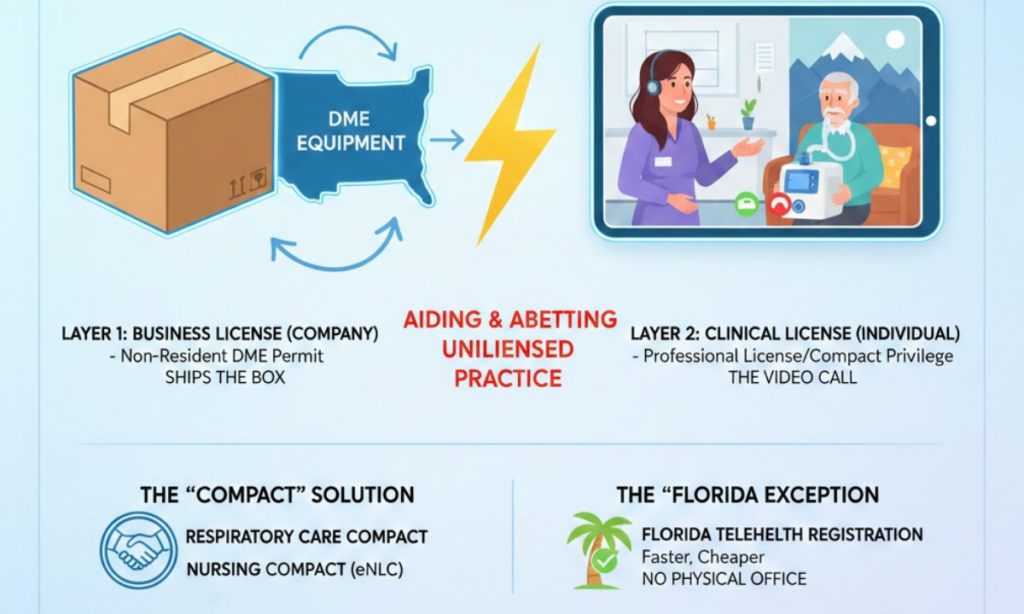
To stay legal, you need two layers of licenses for every interaction:
Layer 1: The Business License (The Box)
- Who needs it: The Company (Inc/LLC).
- What it is: A “Non-Resident DME Permit” or “Home Medical Equipment License.”
- Purpose: Allows you to ship the physical equipment into the state.
Layer 2: The Clinical License (The Video Call)
- Who needs it: The Respiratory Therapist (RT), Nurse, or Audiologist.
- What it is: A Professional License or “Compact Privilege.”
- Purpose: Allows the human to instruct the patient on how to use it.
- The Risk: If you have the Business License but not the Clinical License, you are guilty of “Aiding and Abetting Unlicensed Practice.”
The “Compact” Solution
Fortunately, 2026 has seen the expansion of Licensure Compacts.
- Respiratory Care Compact: Allows RTs to practice in member states without a full new license.
- Nursing Compact (eNLC): Allows RNs to practice in 40+ states.
- Strategy: Hire clinicians who already hold Compact Licenses. It instantly opens up 30+ states for your Telehealth program.
The “Florida Exception” (Registration vs. License)
Some states have created a middle ground.
- Florida Law: Florida allows out-of-state providers to “Register” as a Telehealth Provider (without getting a full Florida license) if they only provide telehealth.
- The Benefit: It is faster, cheaper, and easier than full licensure.
- The Catch: You cannot have a physical office in Florida.
Useful Resources
- Center for Connected Health Policy (CCHP): Use their “State Policy Finder” to check cross-state licensing rules. Center for Connected Health Policy (CCHP) Policy Finder
- Resprac.org: Check the map for the Respiratory Care Compact status. Compact Map
WWS Value Proposition:
We Map the Terrain
Wonder Worth Solutions specializes in Telehealth DME Licensing. We analyze your fulfillment map and your clinical team’s credentials. We help you obtain the necessary Business Licenses and guide your clinical staff toward “Compact Licensure” strategies to cover maximum territory legally.
Is your Zoom setup legal?
Let’s check the map for a Telehealth Compliance Audit.