
Answer Summary:
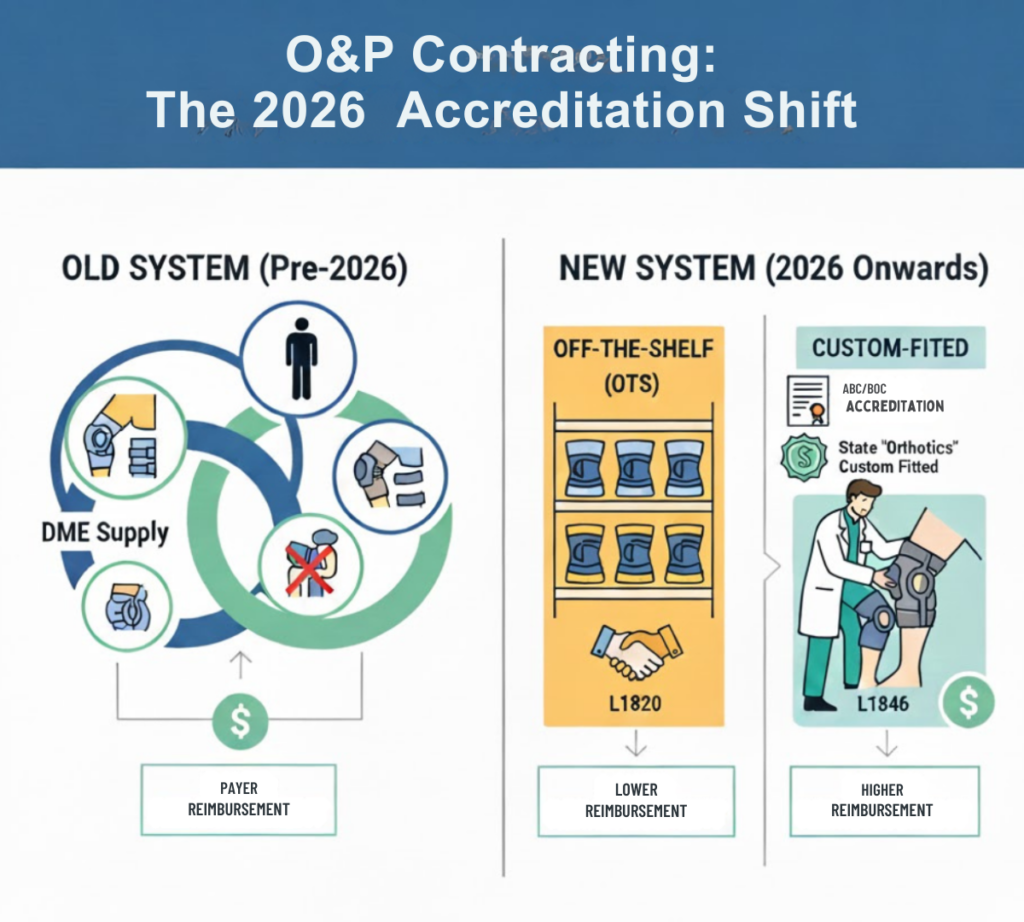
Orthotics & Prosthetics (O&P) is facing a credentialing crackdown. Payers like Blue Cross and UHC are now distinguishing between “Off-the-Shelf” (OTS) and “Custom Fitted” orthotics. If your accreditation only covers “DME Supply,” you may be locked out of the lucrative “Custom” codes (L-Codes). To bill for custom braces, providers must hold specific ABC or BOC Accreditation and employ licensed/certified orthotists.
Introduction:
Not all knee braces are created equal.
L1820: A sleeve you pull off a shelf. (OTS)
- L1846: A custom-fitted rigid brace requiring a clinician. (Custom)
In 2026, payers are enforcing a hard line. If you are a standard DME accredited for “Supply,” you can only bill the OTS codes. The moment you touch the patient to “fit” the brace, you need a different license.
The “Fitter” Requirement
To bill “Custom Fitted” codes, you generally need:
- Personnel: A Certified Orthotic Fitter (COF) or Certified Orthotist (CO) on staff.
- Accreditation: Your certificate must list “Orthotics – Custom Fitted.”
- State License: Many states require a specific “Orthotics” license separate from the “DME” license.
The “OTS” Downgrade
- The Risk: If you bill a “Custom” code but your file doesn’t show a certified fitter did the work, the audit will downgrade the claim to the “OTS” price.
- The Impact: You lose ~40% of the reimbursement.
WWS Value Proposition:
We Manage O&P Credentialing
O&P is a niche within a niche. Wonder Worth Solutions understands the difference between ABC and BOC requirements. We manage the Personnel Rosters in PECOS to ensure your Certified Fitters are linked to your location, unlocking the higher-reimbursement codes.
Are your L-Codes getting denied?
It might be your scope for an O&P Accreditation Review.