
Answer Summary
Automatic crossover billing is a compliance risk because standard automation often fails to verify if specific HCPCS codes are authorized under the secondary Medicaid plan, exposing providers to abusive billing flags and recoupment audits. Implementing a “Crossover Validation Protocol” is essential for 2026 CMS compliance to ensure that all dual-eligible claims meet strict state-level authorization and TPA routing requirements. By inserting manual “circuit breakers” into the billing workflow, DME providers can eliminate high-volume denials and protect their revenue cycle from the financial strain of automated errors.
The Scenario: The Automation Trap
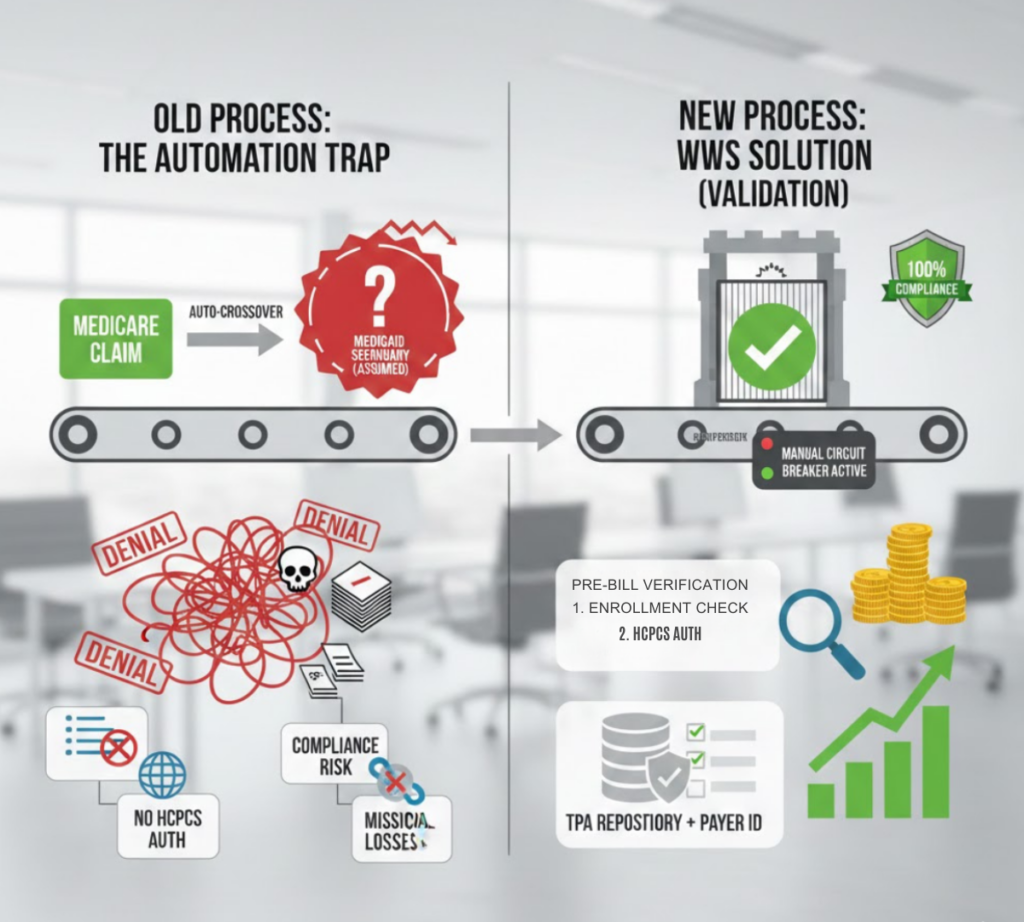
Managing “Dual Eligible” patients—those with both Medicare and Medicaid coverage—is a staple of revenue cycle management. Typically, the process is automated: you bill Medicare, Medicare pays its portion, and the claim “crosses over” automatically to the state Medicaid plan for the balance.
For the RCM team at our client organization, this was standard procedure. They saw “Medicaid Secondary” on the file and assumed the claim would be paid. They processed high volumes of crossover claims without a second thought, trusting the automation.
The Operational Failure
Trusting the automation was a mistake. Our audit revealed a significant compliance blind spot regarding HCPCS Authorization.
1. The Authorization Gap
While the patient was enrolled in both plans, the RCM team was not verifying if the specific service codes (HCPCS) were actually authorized benefits under the secondary Medicaid plan. They were billing for services that Medicaid never agreed to cover.
- The Risk: Submitting claims for unauthorized services is not just a denial risk; it is a compliance risk. It flags the provider for “abusive billing patterns”.
- The TPA Blind Spot: The team also lacked a centralized repository for Third-Party Administrator (TPA) details, often missing the specific TPA ID required to process the secondary claim correctly.
2. The Financial Consequence
Because these claims were being submitted blindly, they generated a high volume of complex denials that required manual rework. Even worse, if a claim was paid in error, the provider faced the threat of future recoupment audits.
The WWS Solution: Crossover Validation Protocol
WWS intervened by inserting a manual “circuit breaker” into the automated workflow. We updated the Master Payer Index (MPI) to include a Crossover Validation Protocol.
1. The “Pre-Bill” Verification
We established a new rule: Before any Medicaid plan is marked “Active” for secondary billing in the MPI, the Provider Enrollment team must verify two distinct factors:
- Enrollment: Is the provider enrolled for this specific service type?
- Authorization: Are the specific HCPCS codes on the fee schedule authorized for this plan?.
2. The TPA Repository
We expanded the MPI structure to include a dedicated section for TPA Details. This ensures that when a claim does cross over, it is routed to the correct TPA with the correct Payer ID, eliminating “Lost Claim” denials.
The Outcome
By moving from “Assumption” to “Validation,” we secured 100% compliance on dual-eligible billing for Q3. We transformed a passive, high-risk workflow into an active, verified revenue stream, protecting the provider from the “death by a thousand cuts” of small balance denials.