


Answer Summary:
A common error for new DME providers is confusing Type 1 (Individual) and Type 2 (Organization) National Provider Identifiers (NPIs). You cannot bill Medicare for DME using a Type 1 NPI (like a doctor’s personal ID). You must incorporate and obtain a Type 2 NPI. Furthermore, “Group Practices” must ensure that all billing is routed through the Type 2 NPI to avoid payment rejections and liability issues.
Introduction:
“I have an NPI, so I’m ready to bill.”
Stop.
Which NPI do you have?
In the rush to launch, many clinician-owners (Pharmacists, PTs, MDs) try to use their personal NPI to start a DME company.
This triggers an immediate rejection.
Medicare DMEPOS is an “entity-based” enrollment. You are not enrolling a person; you are enrolling a business.
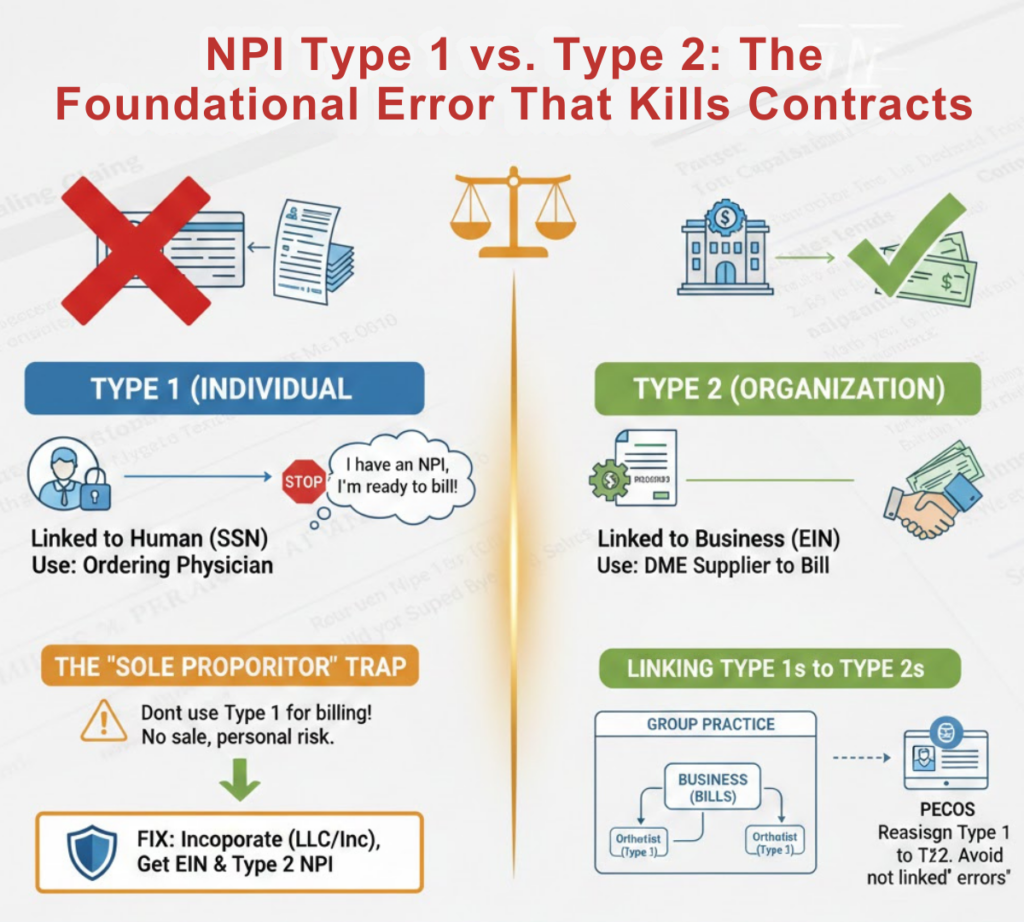
The Difference Explained
- Type 1 (Individual): Linked to a human (SSN). It travels with you.
- Use: For the ordering physician to sign the prescription.
- Type 2 (Organization): Linked to a business (EIN). It stays with the company.
- Use: For the DME supplier to submit the bill.
The “Sole Proprietor” Trap
- The Scenario: You are a Sole Proprietor. You technically can use a Type 1 NPI to bill…
- The Warning: Don’t do it. If you use your Type 1, you cannot sell the business later (because the NPI is you). You also expose your personal assets to audits.
- The Fix: Always incorporate (LLC/Inc), get an EIN, and get a Type 2 NPI.
Linking Type 1s to Type 2s
If you have a group practice (e.g., an O&P clinic with 3 Orthotists):
- The Business bills (Type 2).
- The Orthotist renders (Type 1).
- The PECOS Step: You must “reassign” the Type 1 benefits to the Type 2 entity in PECOS. If you miss this step, the claims will deny as “Provider not linked to group.”
WWS Value Proposition:
We Structure You Correctly
Wonder Worth Solutions handles the NPPES Enumeration and PECOS Reassignment. We ensure your corporate structure is built for billing, growth, and eventual exit.
Billing on the wrong ID?
Let’s fix your foundation for an NPI Structure Audit.