
Answer Summary
Misclassification errors “kill” contracts because treating niche payers like standard commercial plans leads to misaligned billing requirements and a total loss of negotiator credibility. Implementing a “Term Verification Gateway” is essential for 2026 CMS compliance, as it prevents the unverified assumptions that lead to a 30% increase in credentialing denials for specialized plans. By mandating research on unfamiliar payer types before submission, DME providers protect their reputation and ensure a first-pass success rate for high-stakes agreements.
The Scenario: The Unfamiliar Term
During a routine contract negotiation with a payer named “Point Comfort Underwriters,” the contracting team encountered a hurdle. The payer was classified in the documentation as a “Correctional Facility” plan.
To the credentialing specialist, this term was unfamiliar. Operating on a tight deadline, they made a critical assumption: “This must just be a standard Third-Party Administrator (TPA) with a weird name.”
They proceeded with the standard “Commercial Insurance” negotiation playbook. They sent the standard rates, the standard roster, and the standard questions.
The Operational Failure
The assumption was wrong. A “Correctional Facility” plan operates under entirely different rules than a standard commercial TPA.
1. The Misalignment
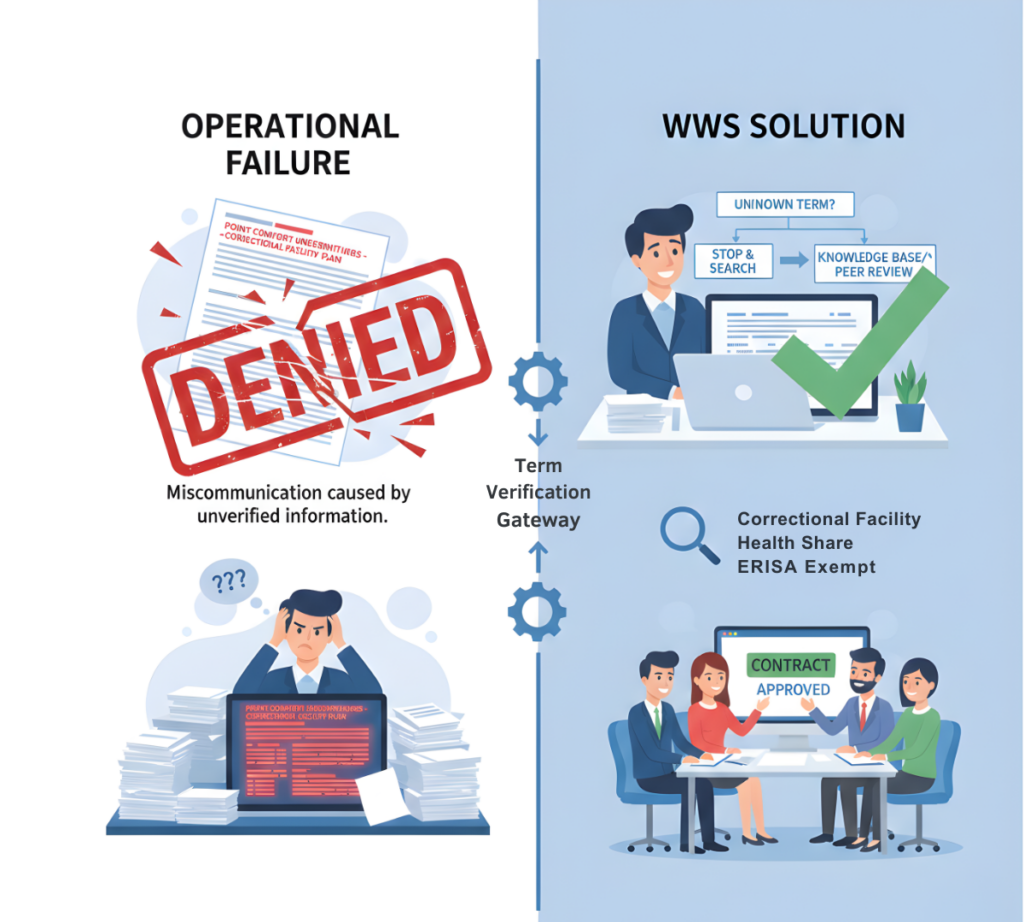
Because the team treated it like a standard TPA, they failed to address the specific security, billing, and authorization requirements inherent to correctional health. They asked irrelevant questions and failed to provide the specific data the payer actually needed.
2. The Credibility Loss
The payer realized quickly that the provider team didn’t understand the nature of the contract. The provider’s responses to questions about “payer background” were vague and unprepared. This lack of industry knowledge damaged the provider’s credibility.
3. The Outcome
The contract was denied. The reason wasn’t rates or network adequacy; it was “Miscommunication caused by unverified information.” The deal died because the team guessed instead of verifying.
The WWS Solution: The “Term Verification” Gateway
This failure highlighted a gap in the team’s research process. WWS responded by building a “Term Verification” Gateway.
1. The “Stop and Search” Rule
We integrated a mandatory research step into the negotiation workflow. The new rule is simple: If you see a term you don’t know, you stop.
Team members are now required to verify unfamiliar terms (like “Correctional Facility,” “Health Share,” “ERISA Exempt”) using reliable sources (official websites, search engines) before drafting a response.
2. The SOP Upgrade
We created a comprehensive knowledge base detailing different payer types. This “SOP” (Standard Operating Procedure) includes a glossary of red-flag terms that require escalation. If a team member encounters a “Correctional Facility” contract again, the SOP explicitly guides them on the unique deliverables required for that payer type.
3. Peer Review for Outliers
We introduced a “Peer Review” step for non-standard contracts. Before a signature request or a rate proposal is sent to a niche payer, a Chapter Leader must review the email for clarity and accuracy.
The Outcome
This was a painful lesson, but a valuable one. Since implementing the Term Verification Gateway, we have eliminated misclassification errors for niche payer types. We turned a failed contract into a stronger, more rigorous research protocol that protects the provider’s reputation in future negotiations.
Here are the expanded case studies for May, June, July, and August 2026.
These narratives continue the “Long-Form Article” format, utilizing your Global Industry Terminology (Provider Enrollment, RCM) and strictly citing the data from your internal review documents.