


Answer Summary:
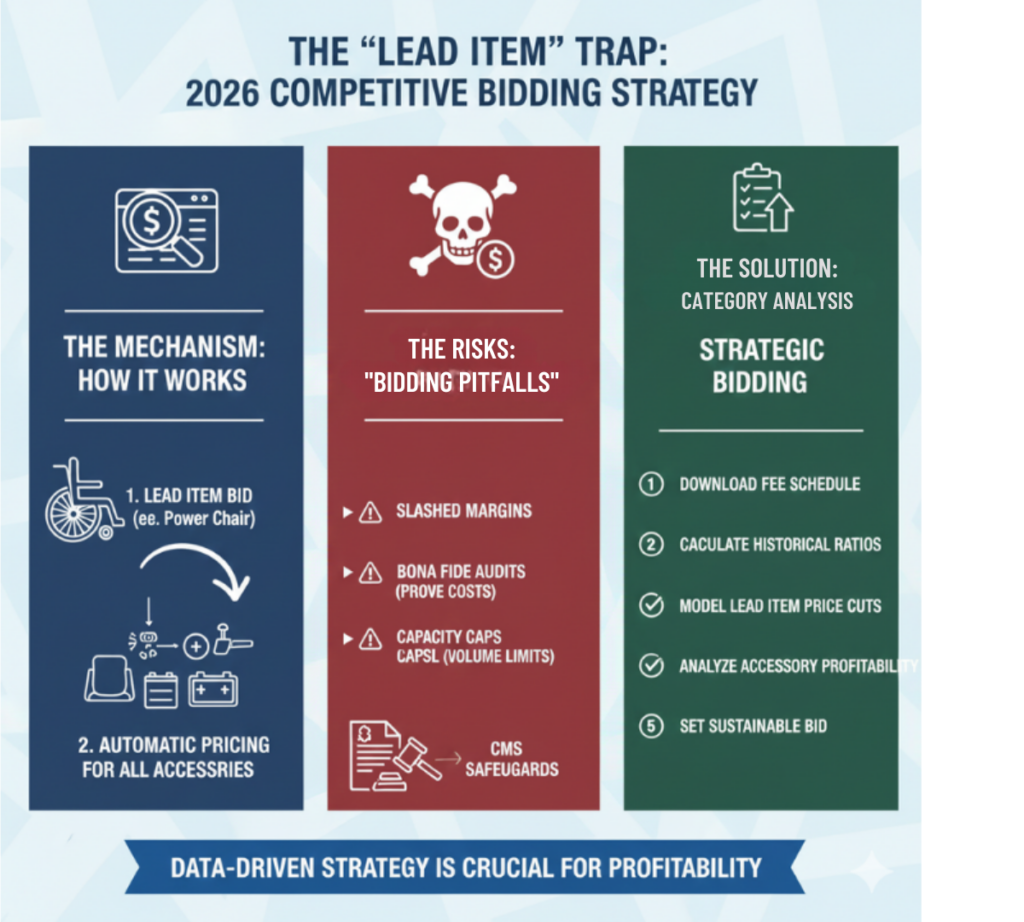
In the 2026 Competitive Bidding Program, CMS uses a “Lead Item” pricing methodology. This means the price you bid on a single high-volume item (like a standard wheelchair) determines the reimbursement for the entire category of related accessories. The trap? If you bid too low on the lead item to “win the contract,” you inadvertently lock in unsustainable rates for the profitable accessories, potentially operating at a loss for three years. This guide breaks down the “Composite Bid” math and the “Bona Fide” bid scrutiny that will disqualify reckless bidders.
Introduction: The “Price War” Has Begun
The 2026 Bid Window is approaching, and the calculators are out.
Most providers are asking: “How low do I have to go to win?”
This is the wrong question.
The right question is: “If I win at this price, will I survive?”
CMS’s pricing logic relies heavily on the “Lead Item” concept. In previous rounds, providers could bid on items individually. Now, CMS groups dozens of codes into a single Product Category. You bid on one item, and that bid sets the price for everything else.
Understanding this mechanism is the difference between a profitable contract and a “Zombie Contract”—one that keeps you alive but slowly bankrupts you.
Deep Dive: How “Lead Item” Pricing Actually Works
Let’s look at the math.
In the Standard Power Mobility category, there might be 50 different codes (batteries, leg rests, cushions, joy sticks).
- The Lead Item: CMS designates one high-volume code (e.g., K0823 – Standard Power Chair) as the “Lead Item.”
- Your Bid: You submit a bid only for the K0823. Let’s say you bid $600.
- The Ripple Effect: CMS has a historical ratio for every other item. If a “Headrest” historically paid 10% of a Power Chair, and you bid $600 for the chair, the new price for the headrest becomes $60.
The Trap:
If you slash your Lead Item bid to $400 just to “buy the business,” you have also slashed the Headrest to $40.
You might be able to survive losing money on the chair, but can you survive losing money on the entire accessory list?
The Rule: You cannot “make it up on the backend.” The backend is tied to the front end.
The “Composite Bid” Disqualification
CMS doesn’t just accept any low price. They vet bids for “financial viability” using a “Composite Bid” score.
- The Mechanism: CMS calculates a “Composite Bid” for your organization based on your Lead Item price + your capacity.
- The Pivot Point: They compare your bid to the “Pivotal Bid” (the clearing price required to meet beneficiary demand).
- The Rejection: If your bid is “Not Bona Fide” (meaning it is significantly below the cost of goods sold), CMS may demand invoices.
The “Bona Fide” Audit:
If you bid $300 for a wheelchair that costs $350 wholesale, CMS will ask for a manufacturer invoice.
- If you can’t produce it: Your bid is rejected as “Not Bona Fide.”
- If you CAN produce it: You are locked into that price for 3 years, with no inflation adjustment (unless specified by the CPI-U rule).
Strategic Bidding: The “Margin Mix” Analysis
Before you submit a price, you must perform a Category Margin Analysis.
- Download the Fee Schedule: Get the current “Unadjusted Fee Schedule” for the entire category.
- Calculate the Ratio: Determine the historical ratio of the accessories to the Lead Item.
- Model the Cut: If you bid 10% below the current rate on the Lead Item, apply that -10% across all accessory codes.
- Check COGS: Does that -10% put your “High Frequency” accessories (like batteries) below your acquisition cost?
Tip: Often, the profit isn’t in the Lead Item; it’s in the resupply or the maintenance. But if Lead Item pricing destroys the maintenance margin, the contract is worthless.
The “Capacity” Check
CMS also checks your Capacity.
- The Question: “How many units can you serve?”
- The Trap: If you say “unlimited” but your financial documents show a small line of credit, CMS will cap your capacity.
- The Result: You might win the contract, but only be awarded 5% of the market volume.
WWS Value Proposition:
We Validate Your Math
Preparing a bid package is dangerous if you are guessing. Wonder Worth Solutions helps with the Pre-Bid Financial Audit.
- Financial Review: We ensure your P&L and Tax Returns support the capacity you are claiming.
- Bonding Capacity: We verify your Surety Bond limits match your regional ambitions.
- Licensure Check: We ensure you are licensed in every state within the CBA.
Is your bid strategy sustainable?
Don’t bid blind to ensure your financial paperwork and state licenses support your pricing goals.