

Answer Summary:
The CMS DMEPOS Competitive Bidding Program (CBP) officially restarts in 2026, ending the “gap period” that began in 2021. This round introduces stricter eligibility requirements, specifically regarding Remote Item Delivery (RID) networks and financial capacity. To qualify, providers must clear five specific “License-to-Operate” gates before the Summer 2026 bid window: securing non-resident state licenses for multi-state regions, verifying Authorized Officials in PECOS 2.0, auditing surety bond limits per-CBA, and ensuring accreditation is active under the new annual cycle. Failure to clear these gates results in “Technical Disqualification” before price is even considered.
Introduction: The “Gap Period” is Over
For the last few years, the Durable Medical Equipment (DME) industry has lived in a “gap period”—a temporary reprieve where the Competitive Bidding Program (CBP) was paused, and any qualified provider could bill Medicare at adjusted rates.
That vacation is over. CMS has confirmed that the next round of bidding kicks off in 2026, and the landscape has changed dramatically since the last successful round in 2019.
The 2026 round isn’t just a “reset”; it is a “modernization.” CMS is bringing new categories, new definitions, and significantly higher scrutiny to the application process.
If you are a DME provider, this is an existential event. Winning a bid secures your Medicare volume for the next three years (2027–2029). Losing it—or getting disqualified because of a paperwork error—can slash your revenue overnight.
At Wonder Worth Solutions, we are seeing a dangerous trend: providers are obsessing over pricing (“How low should I bid?”) while ignoring eligibility (“Am I allowed to bid?”). In the last round, thousands of bids were disqualified not because the price was too high, but because of “administrative credentialing errors.”
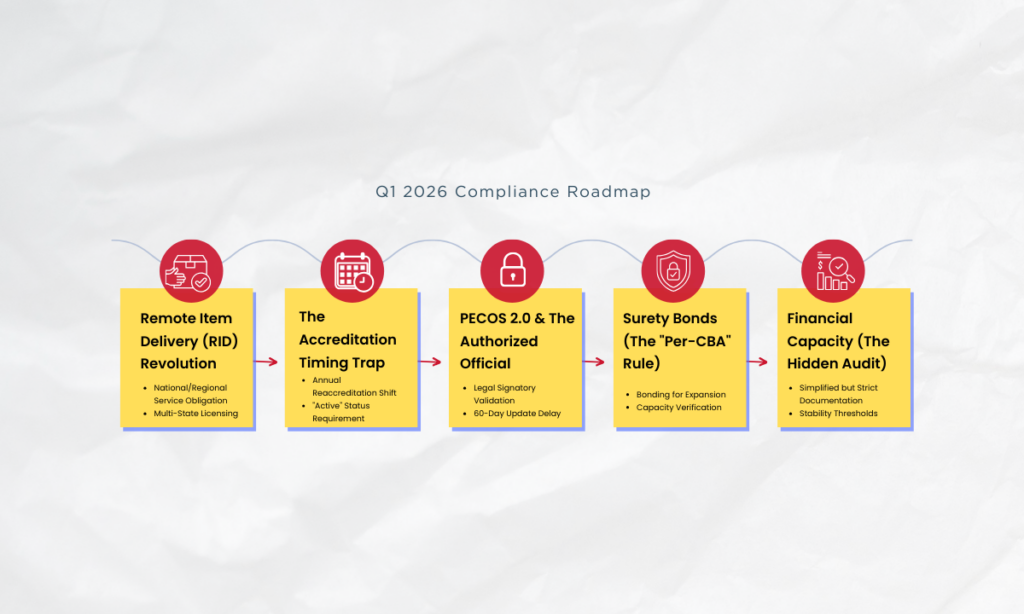
This guide covers the 5 Critical “License-to-Operate” Gates you must clear in Q1 2026 to ensure you survive the vetting process.
Gate 1: The “Remote Item Delivery” (RID) Revolution
The biggest structural change for 2026 is the formalization of Remote Item Delivery (RID).
In previous rounds, there was ambiguity between “Mail Order” and “Retail.” For 2026, CMS (referencing 42 CFR § 414.402) is drawing a hard line.
The New Definition
If your business model involves shipping more than 50% of your diabetic supplies, enteral nutrients, or CPAP resupplies to patients’ homes, you are likely classified as an RID provider. This forces you to bid for National or Regional RID Contracts rather than local competitive bidding areas.
The Trap: The “50-State” Requirement
If you bid for a Regional RID contract (e.g., the “Midwest Region”), you must be capable of serving every single zip codein that region.
- The Audit: CMS will check if you hold a State DME License in every state included in that region.
- The Disqualification: If the region includes Illinois, Indiana, and Ohio, and you only hold an Illinois license, your bid for the entire region is rejected. You cannot “cherry-pick” states within a region.
Action Item: Conduct a State License Gap Analysis immediately. If you plan to bid regionally, you must apply for “Non-Resident DME Permits” in the missing states now. These licenses take 3–5 months to process.
Gate 2: The Accreditation “Timing” Trap
Effective January 1, 2026, the industry is shifting toward an annual (12-month) reaccreditation cycle for high-risk categories, moving away from the traditional 3-year window.
Why This Matters for Bidding
To be eligible to bid, your accreditation must be “Active” and in “Good Standing” during the entire registration and bidding window (projected Summer 2026).
- The Risk: If your accreditation expires in August 2026, and you haven’t scheduled your survey by February 2026, you are in the “Danger Zone.”
- The “Pending” Problem: If your accreditation status in PECOS shows as “Pending Survey” during the bid window, the computerized bidding system may block your registration.
Action Item: Contact your Accrediting Organization (AO) today. If your expiration date falls anywhere in 2026, request an Early Survey. You want that fresh certificate in hand before the portal opens.
Gate 3: PECOS 2.0 & The “Authorized Official”
You cannot submit a bid if you cannot legally sign the contract. This sounds simple, yet it is the #1 cause of technical lockouts.
Who is your “Authorized Official” (AO)?
In PECOS, the AO is the person legally authorized to bind the company to a government contract.
- The Common Error: We frequently see PECOS profiles where the listed AO is a former CFO, Compliance Officer, or partner who left the company two years ago.
- The Consequence: When the Connexion bidding portal opens, it validates the user against the PECOS AO list. If the names don’t match, you cannot log in. Accessing the system to update the AO during the bid window takes 30–60 days—meaning you will miss the deadline.
Action Item: Log into PECOS this week. Verify the AO and Delegated Officials (DO). If the AO is incorrect, submit a Form 855S Change of Information (CHOI) immediately.
Gate 4: Surety Bonds (The “Per-CBA” Rule)
Most providers carry a standard $50,000 surety bond for their NPI. However, the Competitive Bidding Program has a specific “bid surety bond” requirement that catches many off guard.
The “Non-Resident” Bid Bond
If you are bidding in a Competitive Bidding Area (CBA) where you do not have a physical location (a “practice location”), CMS requires proof of bonding for that specific bid.
- The Math: If you are a California provider bidding in 10 different CBAs across the country to expand your footprint, you may need a surety bond that covers each of those 10 areas.
- The Verification: CMS cross-references your NPI bonding limit with the number of CBAs you select in the portal. If your bond limit is insufficient, the system will prevent you from finalizing your bid.
Action Item: Call your surety bond broker. Ask for a “Bidding Capacity Letter.” Ensure your aggregate limit covers your expansion goals.
Gate 5: Financial Capacity (The Hidden Audit)
CMS does not want to award a contract to a company that will go bankrupt in Year 1. Therefore, the 2026 round includes a rigorous Financial Documentation Review.
What You Must Produce
You will likely be required to upload:
- Tax Returns: The last three years of corporate tax returns.
- Credit Rating: A current credit score or rating from a recognized bureau (e.g., D&B).
- Financial Statements: Profit & Loss (P&L) and Balance Sheets prepared in accordance with GAAP.
- The Red Flag: If your tax returns show a net loss for the last two consecutive years, your “Financial Score” may drop below the threshold for contract award, regardless of how low your bid price is.
WWS Value Proposition: We Build the Foundation
Preparing for the 2026 Competitive Bidding Program is not a “DIY” project. It requires a forensic audit of your business identity.
Wonder Worth Solutions acts as your Licensing & Enrollment Architect.
- We handle the Multi-State License applications for your RID strategy.
- We manage the Accreditation Cycle to ensure no gaps.
- We clean your PECOS Data to ensure your Authorized Officials are current.
- We audit your Financial Documents to pre-score your eligibility.
We build the legal structure so you can focus on the pricing strategy.
Is your business foundation “Bid-Ready”?
Don’t risk a technical disqualification. Today for a Pre-Bid Licensing & Enrollment Audit. We will review your State Licenses, PECOS status, and Surety Bonds to ensure you are green-lit to compete in 2026.