

Introduction
As 2025 comes to a close, it’s time to reflect on the successes, challenges, and lessons learned in credentialing. For DME providers, reviewing the past year’s performance offers valuable insights into what worked what didn’t, and how to prepare for the opportunities and challenges of 2026.
In this final blog of the year, we’ll highlight key credentialing takeaways from 2025, discuss emerging trends to watch, and provide actionable goals to set your practice up for success in the new year.
Key Credentialing Lessons from 2025
- The Importance of Automation
- Lesson Learned:
Practices that adopted automation tools experienced fewer errors, faster approval times, and improved efficiency. - Takeaway for 2026:
Invest in credentialing software to streamline workflows and stay ahead of industry demands.
- Lesson Learned:
- Staying Ahead of Regulatory Changes
- Lesson Learned:
Practices that proactively adapted to new payer and accreditation requirements avoided compliance issues and penalties. - Takeaway for 2026:
Monitor regulatory updates closely and conduct regular internal audits to ensure readiness.
- Lesson Learned:
- Collaboration Drives Success
- Lesson Learned:
Coordination between credentialing, billing, and compliance teams was essential for maintaining efficiency and avoiding revenue loss. - Takeaway for 2026:
Establish clear communication channels and workflows across departments to support seamless operations.
- Lesson Learned:
- Data Is a Powerful Tool
- Lesson Learned:
Practices that tracked and analyzed key performance indicators (KPIs) were able to identify bottlenecks and improve processes. - Takeaway for 2026:
Use dashboards and reports to monitor credentialing performance and make data-driven decisions.
- Lesson Learned:
- Patient-Centered Credentialing Matters
- Lesson Learned:
Efficient credentialing directly impacted patient satisfaction, trust, and retention. - Takeaway for 2026:
Prioritize timely approvals and seamless payer interactions to enhance patient experiences.
- Lesson Learned:
Emerging Trends to Watch in 2026
- AI and Advanced Analytics
Credentialing platforms will increasingly leverage AI for predictive analytics, error detection, and process optimization. - Greater Integration Across Systems
Expect tighter integration between credentialing software, billing systems, and EHRs for improved data flow and operational efficiency. - Enhanced Focus on Data Privacy
With evolving regulations, data security and privacy will remain top priorities in credentialing processes. - Value-Based Care Evolution
Payers will place greater emphasis on outcomes and quality metrics, requiring providers to adapt their credentialing processes accordingly. - Growth in Remote and Multi-State Operations
Credentialing for telehealth and multi-state services will continue to grow, increasing the need for streamlined compliance tools.
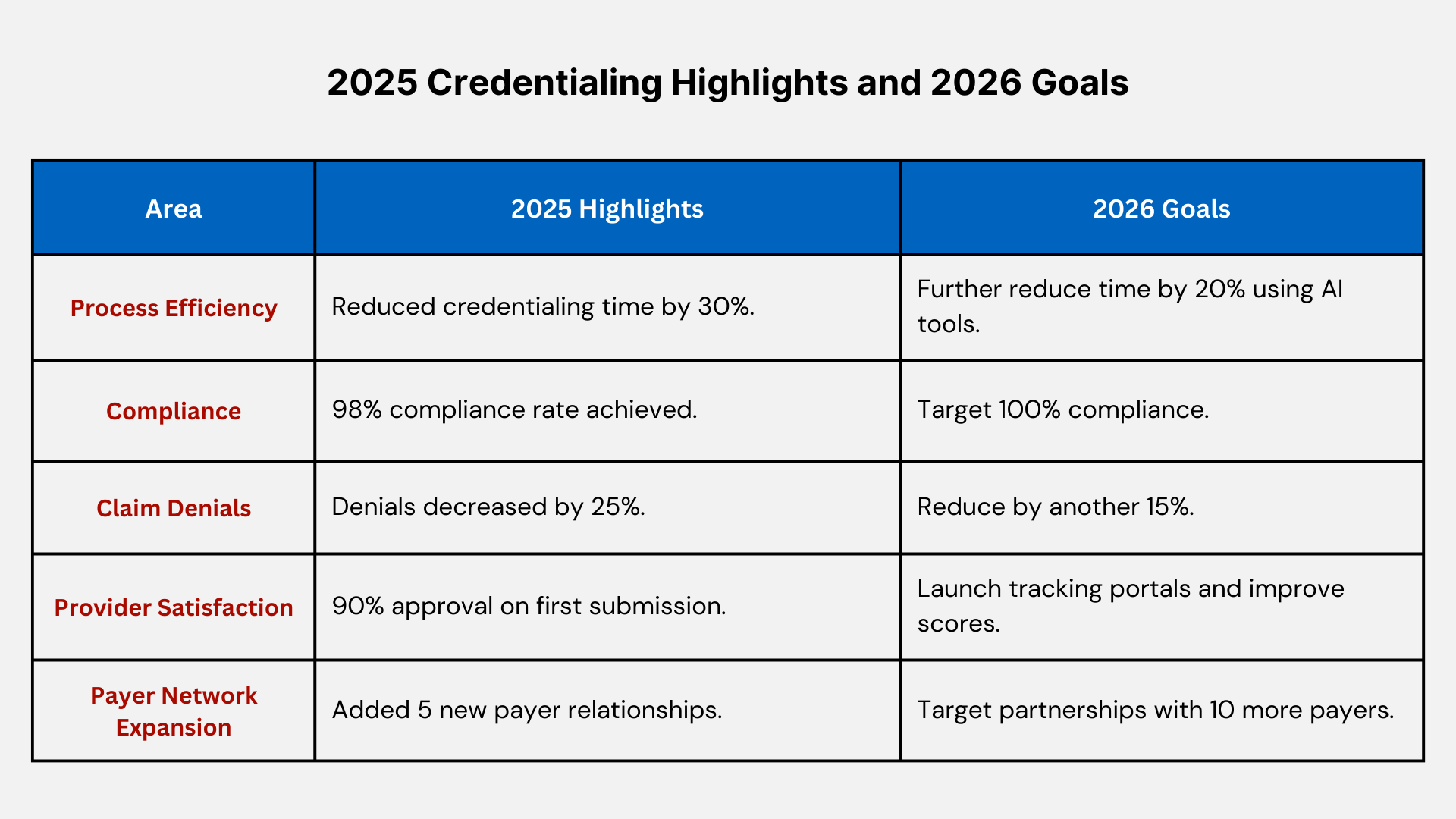
Goals for Credentialing Success in 2026
- Automate More Processes
- Why It’s Important:
Automation reduces manual errors and accelerates timelines. - Action Plan:
Identify high-impact areas like document tracking and payer submissions to automate in 2026.
- Why It’s Important:
- Expand Data-Driven Decision-Making
- Why It’s Important:
Data insights improve efficiency and compliance. - Action Plan:
Set up dashboards to track KPIs like approval rates, denial trends, and turnaround times.
- Why It’s Important:
- Strengthen Payer Relationships
- Why It’s Important:
Strong relationships support faster approvals and smoother negotiations. - Action Plan:
Schedule regular check-ins with payers to stay updated on requirements and address issues proactively.
- Why It’s Important:
- Prioritize Training and Education
- Why It’s Important:
Knowledgeable teams ensure compliance and minimize errors. - Action Plan:
Provide ongoing training on regulatory updates, payer requirements, and credentialing best practices.
- Why It’s Important:
- Plan for Growth
- Why It’s Important:
Anticipating expansion ensures credentialing processes can scale without disruptions. - Action Plan:
Review your credentialing workflows and tools to ensure scalability for new providers, payers, or regions.
- Why It’s Important:
Break down your 2026 credentialing objectives into quarterly milestones to track progress and adapt as needed.
How WWS Can Help
At WWS, we partner with DME providers to build on lessons learned and achieve their goals with:
- Advanced Credentialing Solutions: Streamline workflows and stay ahead of regulatory demands with cutting-edge tools.
- Data-Driven Insights: Use real-time reporting and analytics to monitor performance and drive improvement.
- Tailored Support: From compliance to payer relationships, we provide expertise to meet your unique needs.
Schedule a consultation with WWS today to set your practice up for credentialing success in 2026:
Schedule a Meeting with WWS.
Conclusion
Reflecting on 2025’s credentialing lessons is key to setting actionable goals for 2026. By embracing technology, prioritizing compliance, and focusing on data-driven improvements, your practice can build on past successes and navigate future challenges with confidence.
Partner with WWS to elevate your credentialing processes and achieve your 2026 goals—schedule your consultation today!