

Introduction
Effective credentialing is more than just a compliance requirement—it’s a strategic investment that directly impacts your practice’s financial health, operational efficiency, and patient satisfaction. By prioritizing credentialing processes, DME providers can avoid costly errors, secure timely reimbursements, and build stronger payer relationships, all while driving long-term profitability.
In this blog, we’ll explore the return on investment (ROI) of effective credentialing and how implementing best practices and technologies can maximize the value of your credentialing efforts.
The True Costs of Inefficient Credentialing
- Claims Denials and Revenue Loss
- Impact:
Errors or delays in credentialing lead to claim rejections, billing interruptions, and lost revenue. - Example:
An uncredentialed provider submits claims, resulting in denials and rework costs.
- Impact:
- Increased Administrative Burden
- Impact:
Manual processes consume staff time and resources, reducing efficiency. - Example:
Staff spend hours correcting documentation errors or resubmitting applications.
- Impact:
- Payer Delisting and Compliance Penalties
- Impact:
Non-compliance with payer or regulatory standards results in fines or network delisting. - Example:
A missed re-credentialing deadline causes a provider to lose payer participation.
- Impact:
- Damaged Patient Satisfaction
- Impact:
Delays in service delivery or billing issues erode patient trust. - Example:
A patient’s insurance denies coverage due to credentialing gaps, delaying their access to needed equipment.
- Impact:
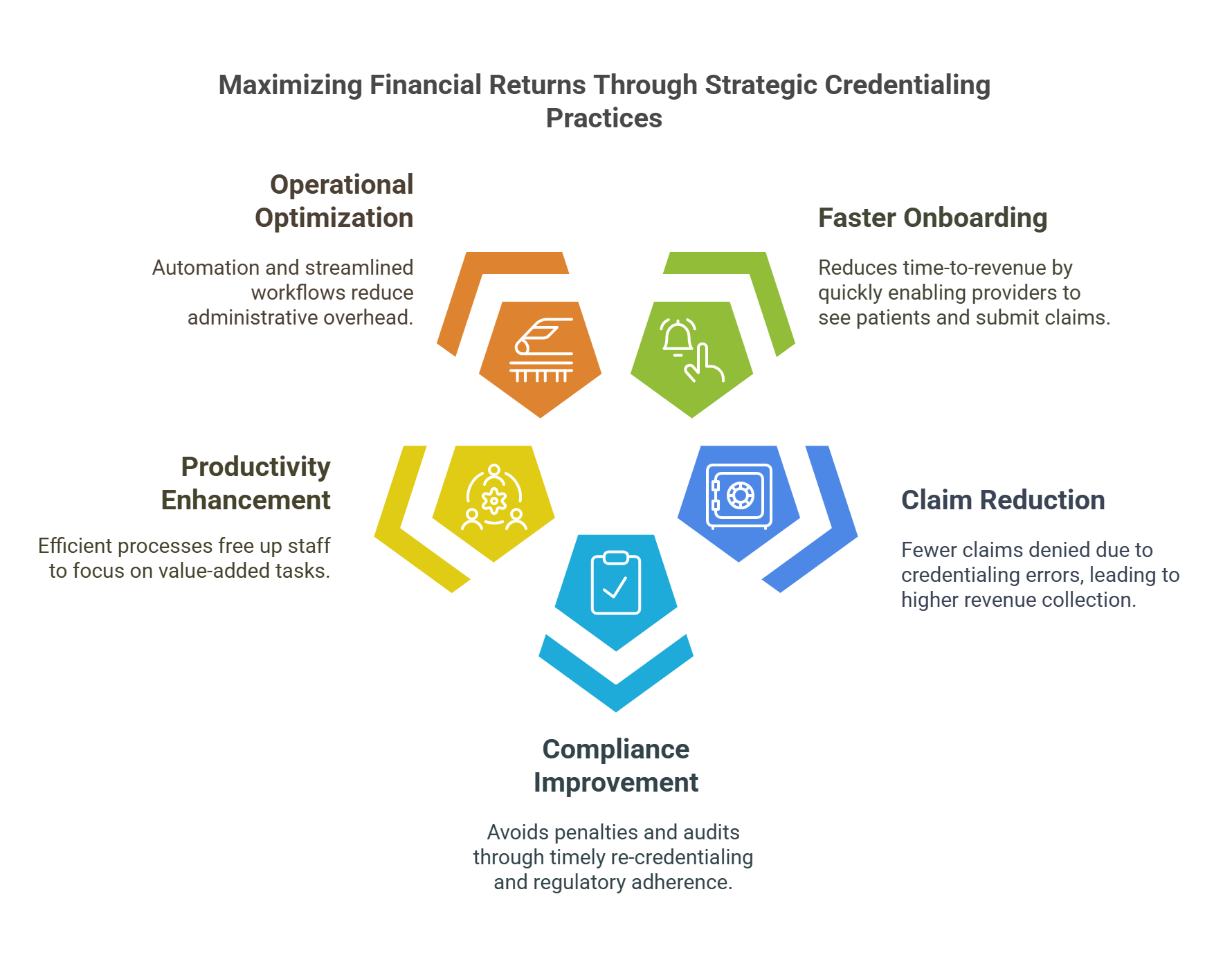
Key Benefits of Effective Credentialing
- Accelerated Reimbursements
Why It Matters:
Proper credentialing ensures timely claim approvals, reducing billing cycles and improving cash flow. - Reduced Administrative Costs
Why It Matters:
Automation and streamlined workflows lower the time and effort required to manage credentialing. - Stronger Payer Relationships
Why It Matters:
Accurate and efficient credentialing builds trust with payers, fostering smoother negotiations and faster issue resolution. - Enhanced Patient Experience
Why It Matters:
Seamless credentialing supports uninterrupted care delivery, improving patient satisfaction and loyalty. - Improved Compliance and Risk Mitigation
Why It Matters:
Adherence to payer and regulatory standards minimizes penalties and protects your practice’s reputation.
Calculating the ROI of Credentialing
- Quantify Cost Savings
- What to Measure:
Time saved through automation, reduction in denial rates, and fewer rework efforts. - Example:
Automating credentialing reduces staff hours by 30%, saving $50,000 annually in administrative costs.
- What to Measure:
- Assess Revenue Impact
- What to Measure:
Revenue gained by reducing denials, accelerating approvals, and avoiding delisting. - Example:
Streamlined credentialing reduces denials by 20%, resulting in $100,000 in recovered revenue.
- What to Measure:
- Evaluate Operational Efficiency
- What to Measure:
Improved workflows, faster onboarding, and lower error rates. - Example:
New providers are onboarded 50% faster, allowing them to generate revenue sooner.
- What to Measure:
- Factor in Patient Retention
- What to Measure:
Improved patient satisfaction and loyalty due to uninterrupted service delivery. - Example:
Happy patients generate referrals, contributing to long-term revenue growth.
- What to Measure:
Strategies to Maximize Credentialing ROI
- Invest in Technology
- Why It Works:
Automation and advanced reporting tools reduce manual errors and improve efficiency. - How to Do It:
Implement credentialing platforms with features like real-time tracking and automated reminders.
- Why It Works:
- Train Your Credentialing Team
- Why It Works:
Well-trained staff ensure accuracy and consistency, reducing errors and delays. - How to Do It:
Schedule regular training sessions on payer requirements, compliance updates, and best practices.
- Why It Works:
- Monitor Key Metrics
- Why It Works:
Tracking KPIs like approval timelines and denial rates provides actionable insights for improvement. - How to Do It:
Use dashboards to evaluate performance and identify bottlenecks.
- Why It Works:
- Prioritize High-Impact Areas
- Why It Works:
Focusing on key payers or high-value services maximizes returns with minimal effort. - How to Do It:
Identify priority payers and ensure their credentialing requirements are always met promptly.
- Why It Works:
- Collaborate Across Teams
- Why It Works:
Coordination between credentialing, billing, and compliance teams ensures seamless operations. - How to Do It:
Establish clear workflows and communication channels between departments.
- Why It Works:
Measure the cumulative impact of improved credentialing on revenue, compliance, and patient satisfaction over time to fully understand its ROI.
How WWS Can Help
At WWS, we deliver measurable ROI for DME providers through:
- Advanced Credentialing Platforms: Reduce administrative costs and accelerate approvals with automation.
- Tailored Solutions: Focus on your practice’s unique needs to maximize financial and operational benefits.
- Expert Support: Minimize errors, meet payer requirements, and achieve compliance with confidence.
Schedule a consultation with WWS today to optimize your credentialing ROI and drive long-term success:
Schedule a Meeting with WWS.
Conclusion
Effective credentialing is a smart investment that delivers tangible returns in the form of reduced costs, improved revenue, and enhanced patient experiences. By adopting best practices, leveraging technology, and focusing on measurable outcomes, your practice can maximize the value of its credentialing processes.
Partner with WWS to achieve the full ROI potential of your credentialing efforts—schedule your consultation today!