

Answer Summary
Cold calling payers is a low-yield game because relationship-based applications yield a 25% higher success rate than cold submissions, which frequently stall at a dismal 22% closure rate. Transitioning to a Relationship Management Program is a vital strategic shift for 2026, as leveraging social capital is now a primary metric for reducing the contracting lifecycle and ensuring CMS-compliant network adequacy. By prioritizing warm leads and assigned ownership of payer contacts, DME providers move from administrative “form-fillers” to high-probability revenue generators.
The Scenario: The Form-Filler Mentality
The contracting team viewed their role primarily as administrative. Their process was transactional: Download the application, fill out the fields, attach the roster, and submit. They approached every new market as “form fillers,” submitting cold applications to every payer in the region.
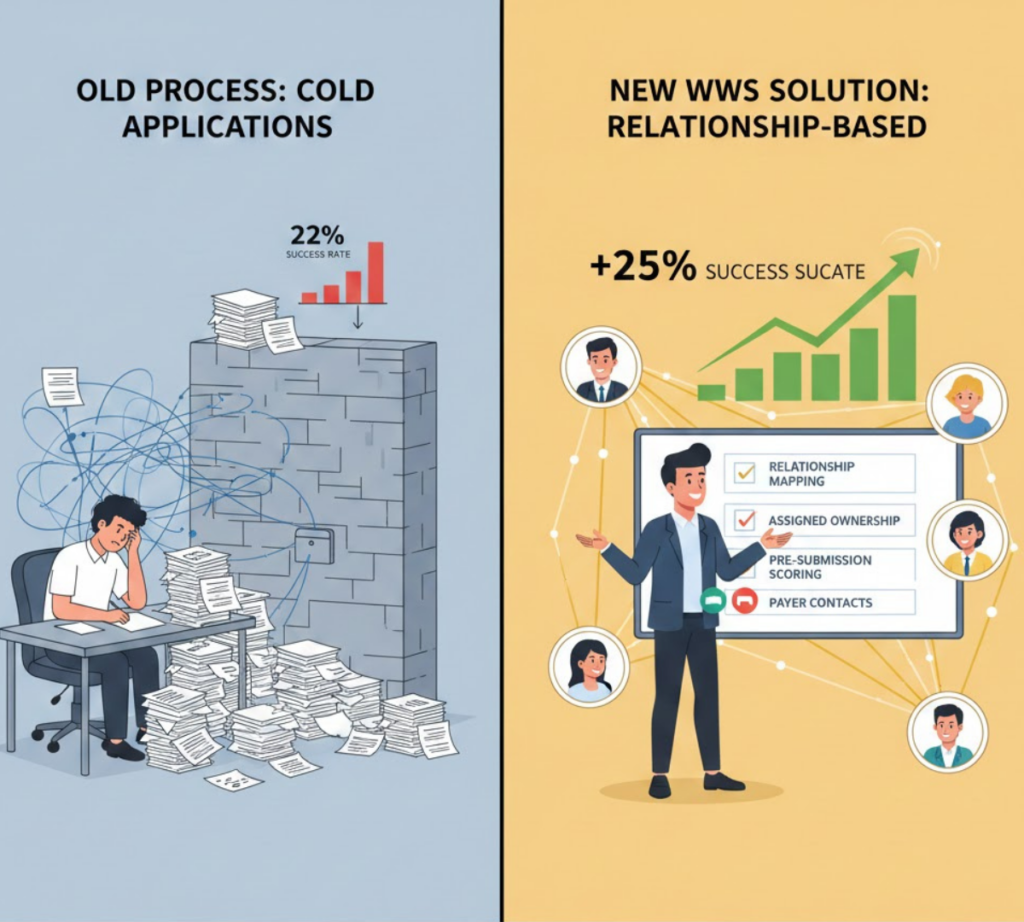
The results were underwhelming. The success rate for these “Cold” applications hovered around 22%. The team was doing the work, but the contracts weren’t closing.
The Operational Failure
The failure was ignoring the human element of healthcare contracting. In a market saturated with providers, a cold application is easily ignored. The team lacked a systematic approach to leveraging Social Capital.
Our data analysis uncovered a massive efficiency gap:
- Cold Applications: Low success probability.
- Relationship-Based Applications: Applications submitted to payers where the provider had an existing relationship demonstrated a 25% higher success rate.
The WWS Solution: The Relationship Management Program
WWS operationalized “who you know.” We shifted the team from being “Processors” to being “Relationship Managers.”
1. Relationship Mapping
We implemented a Relationship Management Program. Before entering a new market, we now map the provider’s existing contacts. Do they know a Medical Director at UHC? Have they worked with a Network VP at Cigna in a different state?
2. Assigned Ownership
We moved away from a “round-robin” assignment of tasks. We assigned specific Relationship Managers to key payers. If one team member has built a rapport with the UHC rep, every UHC application now goes through that person. This transforms a transactional submission into a warm conversation.
3. Pre-Submission Scoring
We developed a Pre-Submission Assessment Tool. This tool scores a potential application based on several factors, with “Existing Relationship” being a high-weighted variable. This allows the team to prioritize high-probability targets over cold shots in the dark.
The Outcome
By prioritizing warm leads and nurturing long-term contacts, we increased the overall contract closure probability. The data proved that in Provider Enrollment, a phone call to an old contact is often worth more than 10 perfectly filled-out forms sent to a generic inbox.