


Answer Summary
The 2026 Competitive Bidding Window is officially closed. Now begins the “Great Silence”—a period of 4–5 months where providers wait for Preliminary Bid Evaluations. The most dangerous mistake a DME provider can make in August is to pause growth efforts while waiting for Medicare’s decision. To survive a potential contract loss (or a low-ball price award), providers must immediately execute a “Commercial Pivot.” This involves auditing your “Non-Medicare” payer mix, renegotiating commercial contracts that are tied to “Medicare Allowables,” and expanding into non-bid product categories.
Introduction: The “Waiting Room” Danger
The adrenaline of July is gone. You calculated the prices, cleaned the data, and hit “Submit” on Form B.
Now, the silence sets in.
CMS will likely not release Preliminary Bid Evaluations until October or November. This leaves you with a full quarter of uncertainty.
Many providers treat August and September as a “wait and see” period. They freeze hiring. They pause marketing. They stop pursuing new contracts.
This is a strategic error.
If you wait until November to find out you lost the Medicare bid, it is too late to replace that volume. You need a contingency plan, and you need it now.
The “Commercial Pivot” is the strategy of aggressively diversifying your payer mix before the government results arrive. If you win the bid, great—you have extra volume. If you lose, you have a lifeboat.
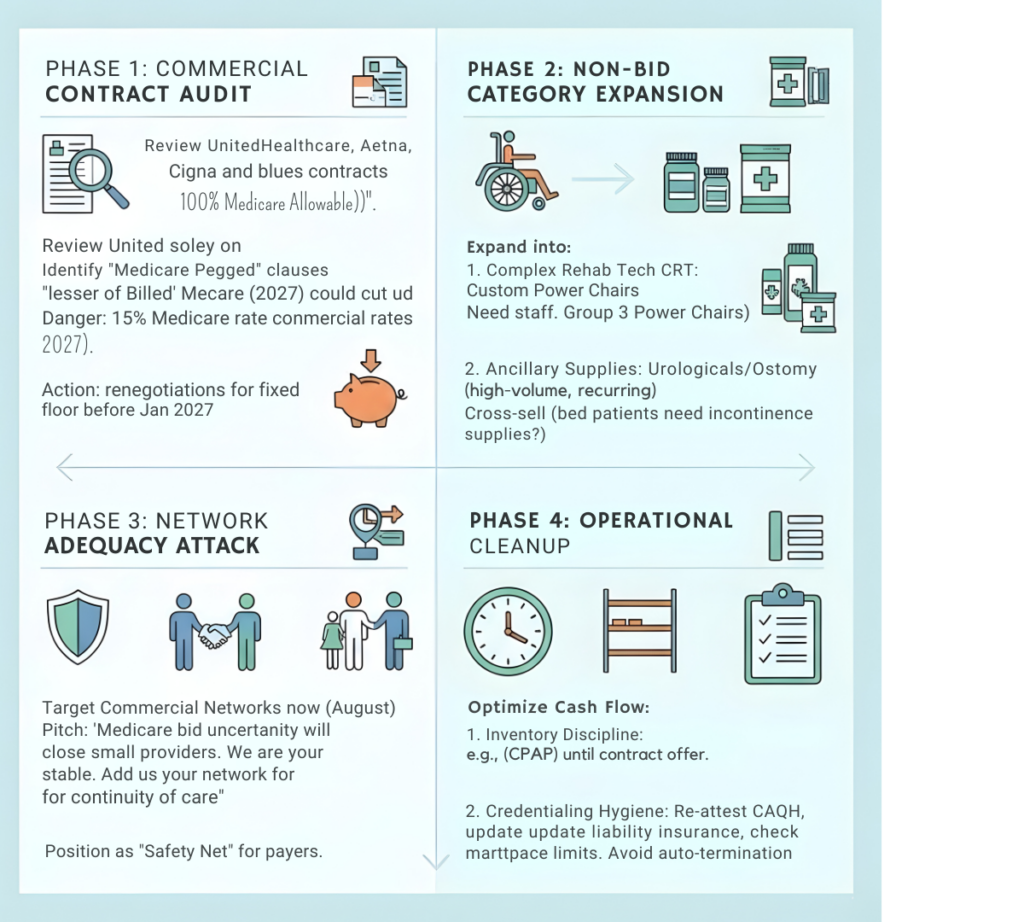
Phase 1: The Commercial Contract Audit
Your first step is to look at your existing contracts with UnitedHealthcare, Aetna, Cigna, and the Blues.
- The Risk: Many commercial contracts are pegged to the “Current Medicare Fee Schedule.”
- The Clause: Look for language that says: “Reimbursement shall be the lesser of Billed Charges or 100% of the current Medicare Allowable.”
- The Danger: If the new Competitive Bidding rates (which start Jan 1, 2027) drop by 15%, your commercial rates might automatically drop by 15% too, even if you didn’t win the Medicare bid.
Action Item: Pull every commercial contract. Identify which ones have “Medicare Pegged” fee schedules. You need to open renegotiations now to lock in a fixed fee schedule or a “floor” rate before the new Medicare prices become public.
Phase 2: The “Non-Bid” Category Expansion
If you bet the farm on Oxygen or Standard Mobility (bid items), you are exposed. You need to expand into categories that are exempt from bidding or less price-sensitive.
1. Complex Rehab Technology (CRT)
- CRT (Custom Power Chairs) is statutorily exempt from Competitive Bidding.
- Requirement: You need an ATP (Assistive Technology Professional) on staff.
- Strategy: If you have an ATP, pivot your marketing to focus on Group 3 Power Chairs rather than standard Group 2s.
2. Ancillary Supplies (Urologicals/Ostomy)
- These are high-volume, recurring revenue lines that often have better commercial margins than hardware.
- Strategy: Cross-sell to your existing patient base. If you deliver a bed to a patient, do they also need incontinence supplies?
Phase 3: The “Network Adequacy” Attack
While everyone else is distracted by Medicare, commercial panels are often neglected.
August is the perfect time to attack Commercial Networks.
- The Angle: “With the uncertainty of the Medicare Bid Program, many small providers will likely close their doors in 2027. We are stable. Add us to your network now to ensure continuity of care for your members when the market shakes out.”
- The Pitch: Position yourself as the “Safety Net” for the payer.
Phase 4: Operational Cleanup (Inventory & Staffing)
While you wait, you must optimize cash flow.
1. Inventory Discipline
- Do not stock up on bid items (e.g., CPAP machines) right now. If you lose the bid in January, you will be stuck with dead inventory you cannot bill to Medicare.
- Rule: Switch to “Just-in-Time” ordering for bid categories until you see the contract offer.
2. Credentialing Hygiene
- Use this quiet period to clean up your CAQH profile. Commercial payers rely on CAQH. If your attestations are expired, they will auto-terminate you.
- Task: Re-attest CAQH. Update your liability insurance PDF. Check your malpractice limits.
WWS Value Proposition: We Manage the Pivot
Shifting focus from Medicare to Commercial payers requires a mountain of paperwork. Wonder Worth Solutions specializes in Commercial Credentialing Campaigns.
- Contract Audit: We review your commercial fee schedules to identify “Medicare Peg” risks.
- Roster Cleanup: We ensure your providers are correctly listed with private payers.
- New Applications: We file applications with the “Big 5” commercial payers to diversify your revenue stream.
Don’t just wait for CMS
Build your lifeboat now for a Commercial Payer Expansion Strategy session