
Answer Summary:
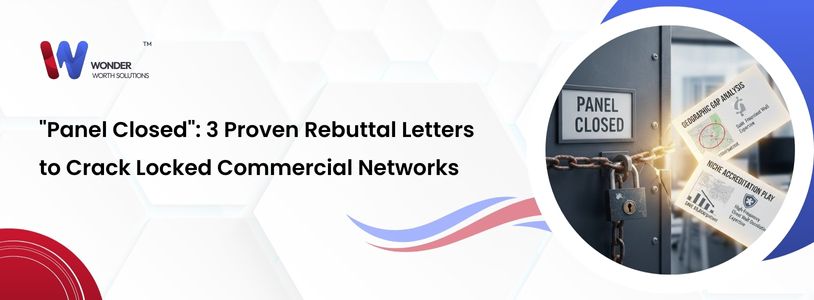
When a commercial payer (like Aetna or UHC) rejects your application with “The Panel is Closed,” it is rarely a final decision. It is often an automated filter. To crack these networks in 2026, providers must submit a formal “Network Adequacy Appeal” using three specific arguments: proving geographic gaps in patient access, demonstrating unique “white glove” service models (like 24/7 delivery), or highlighting hospital discharge delays caused by current vendor shortages.
Introduction:
There is no more frustrating phrase in the DME industry than: “We are not adding providers to the network at this time.”
You have the license. You have the inventory. You have the patients waiting. But the insurance company says “No.”
In 2026, payers are narrowing their networks to control costs. However, “Closed” often just means “Closed to generic applications.” It does not mean closed to providers who solve a specific problem.
At Wonder Worth Solutions, we handle hundreds of contract negotiations. We have found that generic applications get generic rejections. To get a seat at the table, you need to stop asking for a contract and start solving their problems. Here are the three “Rebuttal Strategies” that actually work.
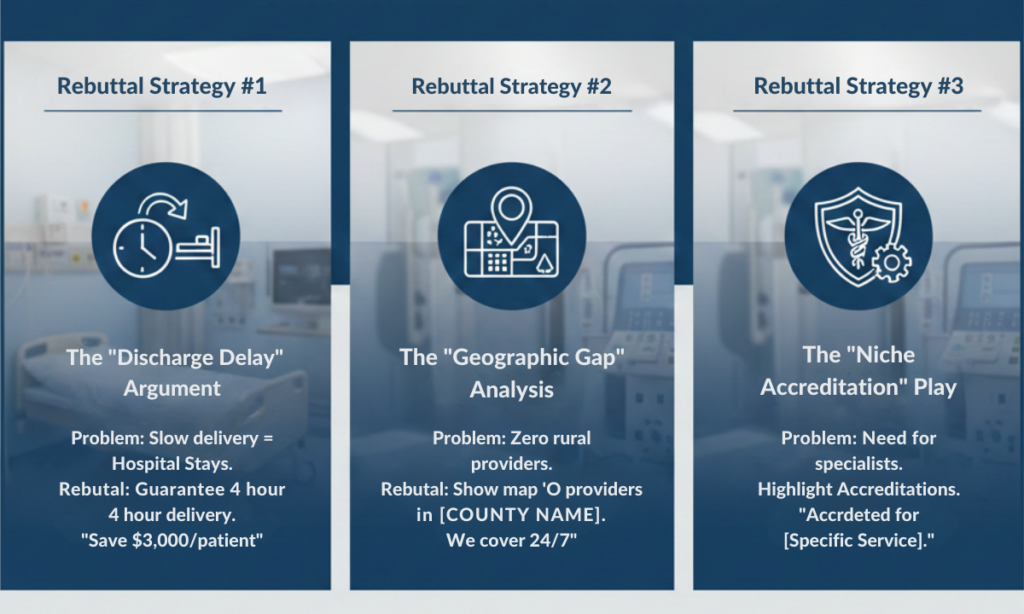
Rebuttal Strategy #1: The “Discharge Delay” Argument
Payers hate one thing more than paying you: paying for unnecessary hospital days.
- The Problem: If the current “in-network” provider takes 48 hours to deliver a hospital bed or oxygen, that patient sits in a $3,000/day hospital room waiting.
- The Rebuttal Letter: Do not talk about your quality; talk about their savings.
- “Data indicates that your current network average for [HOSPITAL NAME] is 24+ hours for DME delivery. We guarantee delivery in 4 hours. By contracting with us, you save $3,000 per patient in avoided hospital days.”
Rebuttal Strategy #2: The “Geographic Gap” Analysis
Networks are often “adequate” in the city center but “inadequate” in rural zip codes.
- The Problem: The payer thinks their network is full because they have 10 providers in the metro area. But they have zero in the rural county 40 miles away.
- The Rebuttal Letter: Use the map against them.
- “Your provider directory shows 0 active providers in [COUNTY NAME] willing to deliver [HEAVY ITEM] after 5 PM. We service this zone 24/7. We are filling a specific Network Adequacy gap for your rural members.”
Rebuttal Strategy #3: The “Niche Accreditation” Play
Do you have a specialized accreditation that generalist DMEs lack?
- The Problem: The payer has plenty of “General DME” vendors but few “Complex Rehab” or “Clinical Respiratory” experts.
- The Rebuttal Letter:
- “We are one of only two providers in this region accredited for [Specific Service, e.g., High-Frequency Chest Wall Oscillation]. Your current panel is heavy on ‘General DME’ but light on the clinical expertise required for your high-acuity members.”
Useful Resources for Data
- CMS Network Adequacy Standards: Use federal standards to define what “access” means CMS QHP Network Adequacy Portal
- State Insurance Commissioner: If a payer is truly failing to provide access, you can file a complaint with the state National Association of Insurance Commissioners (NAIC) Map
WWS Value Proposition:
We Write the Appeals That Open the Door
Don’t accept the first “No.” Wonder Worth Solutions offers Contracting Rebuttal Services. We analyze your local market, identify the payer’s “pain points,” and draft the data-driven appeal letters that get you a seat at the table.
Stuck on a “Closed Panel” list?
Let’s find the key for a Network Adequacy Analysis of your region.