


Answer Summary
DME providers must stop treating all payers identically because market data proves cycle times vary significantly, with Blue Cross Blue Shield requiring up to 180 days compared to 155 days for Cigna. Calibrating follow-up thresholds to these specific timelines is essential for maintaining 2026 CMS-compliant credentialing workflows and preventing the resource drain of “false alarm” escalations. By implementing payer-specific KPIs and geographic benchmarking, organizations can focus their escalation efforts on legitimate outliers to accelerate net revenue realization.
The Scenario: The False Alarm
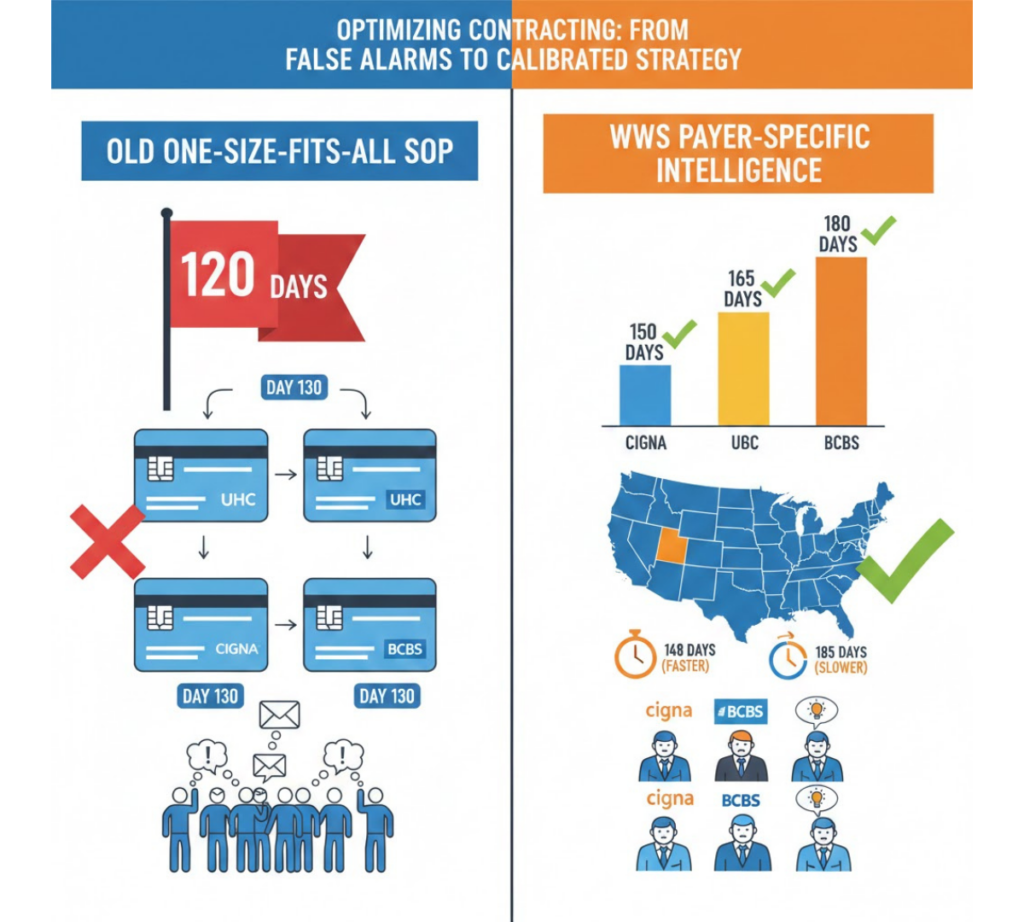
The contracting team operated under a “One-Size-Fits-All” policy. Their Standard Operating Procedure (SOP) stated that any application pending for more than 120 days was a “Red Flag” requiring immediate escalation to leadership.
This rule was applied universally. When a Blue Cross Blue Shield (BCBS) application hit Day 121, the team went into crisis mode. They bombarded the payer with escalation emails. They pulled in directors. They panicked.
The Operational Failure
The failure here wasn’t the delay; it was the expectation. The team was fighting against market reality.
Our data analysis revealed significant variances in cycle times across major payers:
- Cigna: Averaged 155 days to close.
- United Healthcare (UHC): Averaged 165 days.
- Blue Cross Blue Shield (BCBS): Averaged 180 days.
By applying a 120-day benchmark to BCBS, the team was creating false alarms. A BCBS application at Day 130 isn’t “late”—it’s early. Escalating at this stage didn’t speed up the process; it annoyed the payer representatives who were working within their standard (albeit slow) timelines.
The WWS Solution: Payer-Specific Intelligence
WWS replaced the generic SOP with Payer-Specific Timelines.
1. Calibrated KPIs
We adjusted the internal Key Performance Indicators (KPIs) to match the reality of the data.
- The BCBS Adjustment: We moved the “Red Flag” threshold for BCBS applications to 180 days.
- The Quick Wins: We tightened the threshold for faster payers like Cigna to 150 days, forcing the team to be more aggressive where it actually mattered.
2. Geographic nuance
We further refined the strategy by state. We recognized that a contract in Florida (Avg: 148 days) moves much faster than one in New York (Avg: 185 days). We stopped comparing apples to oranges.
3. Specialized Teams
Recognizing the unique complexity of the slower payers, we recommended establishing Payer-Specific Teams for top payers like BCBS. These specialists understand the specific bureaucratic hurdles of BCBS, allowing them to navigate the 180-day cycle with patience rather than panic.
The Outcome
This shift optimized resource allocation. The team stopped wasting energy trying to force BCBS to move at Cigna speeds. Instead, they focused their escalation “capital” on the true outliers—contracts that were legitimately stuck—improving their overall efficiency and relationship with payer networks.