


Answer Summary:
For DME providers heavily reliant on Medicare, rejecting a Competitive Bidding contract is often not a strategic option—it is an existential threat. The “90% Rule” suggests that if Medicare constitutes more than 90% of your revenue for a specific product category (e.g., Oxygen), losing the contract is effectively a “Business Closing Event.” In these cases, the strategy shifts from “Profit Maximization” to “Cost Radicalization.” Providers must sign the contract and immediately restructure operations (outsourcing RCM, switching to cheaper inventory, eliminating drivers) to survive at the new rates.
Introduction:
“The price is too low. I’m rejecting it on principle.”
That is a brave statement. But can you afford to be brave?
If you are a diversified DME with a healthy mix of Commercial Insurance, Hospice, and Cash Sales, you can afford to walk away from a bad Medicare deal. You have other levers to pull.
But if you are a traditional Oxygen or Sleep provider where Medicare makes up 90% of your billing, walking away doesn’t send a message to CMS. It just turns off the lights in your warehouse.
Diagnosing Your “Medicare Dependency”
Before you click “Reject,” run a Payer Mix Report by Product Category for the last 12 months.
- Oxygen: Is Medicare > 60%?
- CPAP: Is Medicare > 40%?
- Standard Mobility: Is Medicare > 80%?
- The Reality: If you are above these thresholds, you do not have a “choice.” You have a mandate. You must sign the contract to keep the cash flow moving, even if the margin is thin.
The “Survival Pivot” (Post-Signing)
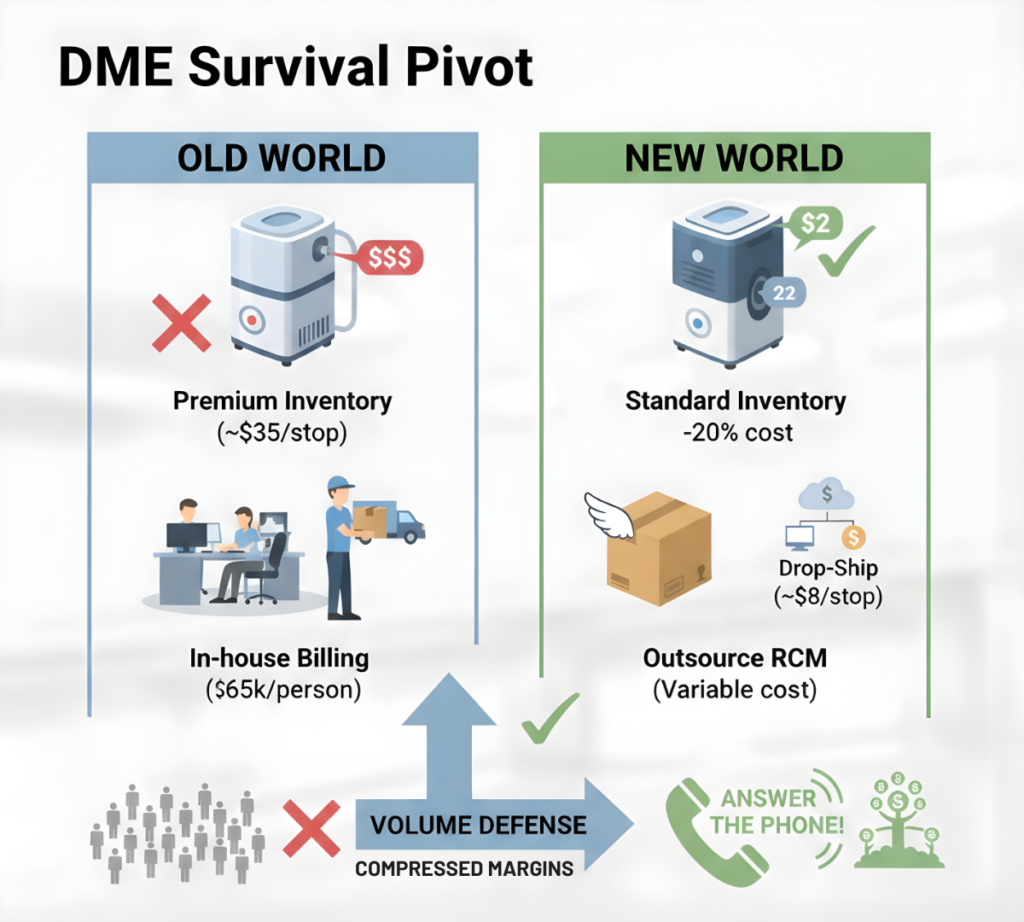
If you accept a contract with compressed margins, you cannot operate “business as usual.” You must radically alter your cost structure.
1. The Inventory Switch
- Old World: You provided the premium, ultra-quiet Oxygen Concentrator because patients liked it.
- New World: You provide the “Standard” model that meets the medical necessity requirement and costs 20% less. You cannot subsidize premium equipment on a standard reimbursement rate.
2. The Delivery Model
- Old World: You had drivers delivering monthly supplies to the doorstep.
- New World: You move to 100% Drop-Ship. The cost of a driver + truck + gas is ~$35 per stop. The cost of shipping is ~$8. You must eliminate the fleet for non-setup items.
3. The Back Office (RCM)
- Old World: You have an in-house billing team costing $65k/year per person.
- New World: You outsource RCM. If your reimbursement drops by 15%, your overhead must drop by 15%. Outsourcing RCM converts a fixed salary cost into a variable cost that scales with your (lower) revenue.
The “Volume” Defense
The only upside to a low-margin contract is Volume.
- With 70% of competitors likely being eliminated from the market (losers), the Winners will see a surge in referrals.
- The Strategy: You must be ready to capture all of this volume efficiently. If you sign the contract but fail to answer the phone because you cut staff too deep, you will fail.
WWS Value Proposition: We Lower Your OPEX
If you have to accept a lower reimbursement, you must lower your Operational Expense (OPEX). Wonder Worth Solutions is the OPEX cutter. We take over RCM, Credentialing, and Intake at a fraction of your in-house cost, making the low-margin contract profitable again through sheer efficiency.
Forced to sign?
Let’s fix your cost structure for an Operational Cost Audit