


Answer Summary
In October 2026, winning bidders will receive a “Notice of Expected Contract Award” via the Connexion portal. This notice contains the Single Payment Amount (SPA)—the fixed price CMS will pay for each item in the product category for the next three years. Providers typically have only 10 business days to accept or reject the offer. This guide provides a “Go / No-Go” financial model to determine if the offered SPA is sustainable, factoring in the “Inflation Adjustment” index, the hidden costs of “All-or-Nothing” acceptance, and the long-term impact of “Lead Item” pricing ratios.
Introduction: The Moment of Truth
You survived the registration in June. You survived the bid submission in July. You survived the disqualification audit in September.
Now, the email is here.
Subject: CMS Competitive Bidding Program – Contract Offer Notification.
You log into Connexion. You click “View Offer.”
And there it is: The Price.
For the next three years (Jan 1, 2027 – Dec 31, 2029), this is what Medicare will pay you for a wheelchair, an oxygen concentrator, or a CPAP machine.
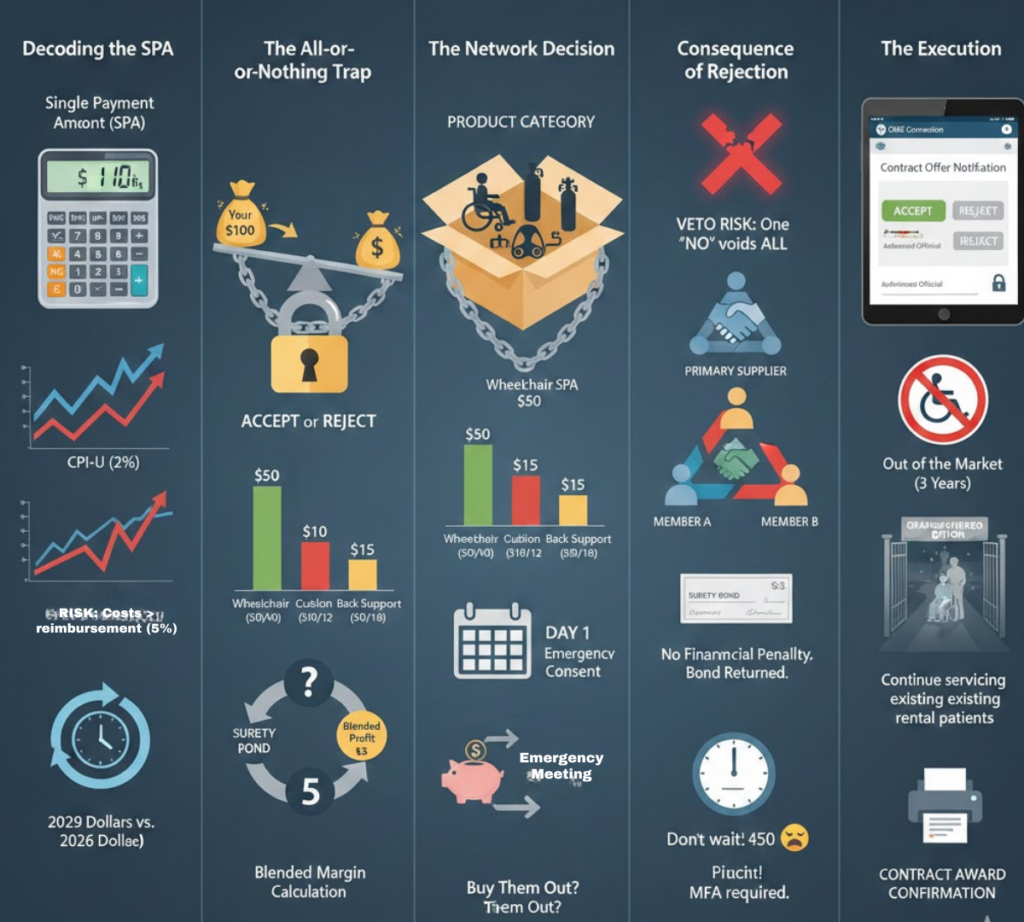
There is no negotiation. You cannot counter-offer. You cannot say, “I’ll take the Oxygen but not the CPAP.” You have two buttons: ACCEPT or REJECT.
And you typically have 10 business days to decide.
History tells us that 15% of providers sign contracts that eventually bankrupt them. They see the volume (“I’ll get 1,000 new patients!”) and ignore the margin (“I lose $5 on every delivery”). They assume they can “make it up on volume.” In the DME industry, you cannot make up a negative margin on volume; you just go broke faster.
At Wonder Worth Solutions, we believe a bad contract is worse than no contract. Here is how to analyze the offer before you sign your life away.
Phase 1: Decoding the “Single Payment Amount” (SPA)
The price you see on the screen is likely different from the price you bid. Why?
Under the new rules finalized for the 2026 Round, CMS sets the SPA at the 75th Percentile of all winning bids (clearing price).
The “Win” Scenario
- Your Bid: $100.
- The Range: The winning bids ranged from $80 to $120.
- The SPA: The 75th percentile is calculated at $110.
- The Result: Even though you bid $100, you are offered a contract at $110. This feels like a victory.
The “Loss” Scenario (The Pivotal Bid)
- Your Bid: $120.
- The SPA: The 75th percentile is $110.
- The Offer: CMS offers you the contract at $110.
- The Decision: You must decide if you can operate at $10 less than your calculated “break-even” bid.
Critical Analysis Step:
Do not look at the SPA in a vacuum. You must look at it relative to 2029 dollars, not 2026 dollars.
- The CPI-U Adjustment: The 2026 contract includes an annual inflation adjustment. However, this is based on the Consumer Price Index for All Urban Consumers (CPI-U).
- The Risk: Medical inflation (staffing, gas, insurance) often outpaces general CPI. If your costs go up 5% a year, but the reimbursement only goes up 2%, a profitable contract in Year 1 becomes a losing contract in Year 3.
Phase 2: The “All-or-Nothing” Trap
Competitive Bidding is an “All-or-Nothing” game within a Product Category.
If you bid on “Standard Mobility,” the contract offer covers every HCPCS code in that category—walkers, wheelchairs, cushions, leg rests, and drive controls.
The “Lead Item” Math Reality
Remember the “Lead Item” pricing from July? Now you see the result.
- Lead Item (K0001 Wheelchair): The SPA might look healthy.
- Non-Lead Item (Seat Cushion): Because of the historical ratios used by CMS, the cushion price might be devastated.
The “Blended Margin” Calculation:
You cannot just look at the wheelchair price. You must calculate the Blended Margin of a standard order.
- Example Order: 1 Wheelchair + 1 Cushion + 1 Back Support.
- SPA Revenue: $50 (Chair) + $10 (Cushion) + $15 (Back) = $75 Total.
- Your Cost: $40 (Chair) + $12 (Cushion) + $18 (Back) = $70 Total.
- Net Profit: $5.00.
Is $5.00 enough to cover the intake time, the driver’s gas, the billing cost, and the compliance risk? If you only looked at the Wheelchair line item, you missed the losses on the accessories.
Phase 3: The Network Decision (Consortiums)
If you bid as part of a Network (Consortium), the stakes are higher during the signing phase.
- The Primary Supplier: Must sign the contract first.
- The Member Suppliers: Must also sign the contract individually.
- The “Veto” Risk: If even one member of your network refuses to sign (perhaps because the price is too low for them), the Entire Network Contract is voided. You all lose.
Action Item for Networks:
Convene an emergency meeting with your partners on Day 1 of the offer window. Show them the Blended Margin analysis. You need unanimous consent immediately. If one partner is hesitating, you have 9 days to convince them or buy them out.
Phase 4: The Consequence of Rejection
What happens if you look at the math and click REJECT?
1. You are Out of the Market
You cannot bill Medicare for these items in this Competitive Bidding Area (CBA) for 3 years. You are effectively “fired” from this product line for Medicare beneficiaries.
2. No Financial Penalty
Unlike “Forfeiture” (which happens if you sign the contract and then default on it), rejecting the initial offer carries no financial penalty.
- You get your Surety Bond back.
- You are not “blacklisted” from future rounds.
3. The “Grandfathering” Option
Rejecting the contract does not mean you have to abandon your current patients immediately. You may be able to elect “Grandfathered” status for rental items (Oxygen, Capped Rental DME). This allows you to keep servicing existing patients at the new SPA rate, preserving your residual revenue stream while you pivot your business model.
Phase 5: The Execution (How to Sign)
If you decide to sign, do not leave it until 4:55 PM on Day 10. Connexion servers will slow down.
- Log in as the Authorized Official (AO). Only the AO can sign.
- Verify the CBA List: Ensure every CBA you won is checked.
- Electronic Signature: You will likely need to re-authenticate with MFA.
- Print the Confirmation: Once signed, print the “Contract Award Confirmation” screen. This is your legal proof.
WWS Value Proposition: We Model the Margin
Do not sign a federal contract based on gut feeling. Wonder Worth Solutions offers a “Contract Viability Analysis.”
- SPA vs. COGS: We load the offered prices into our proprietary calculator against your current invoice costs to show the real margin.
- Inflation Stress Test: We forecast the profitability in Year 2 and Year 3 using different inflation scenarios.
- Go / No-Go Recommendation: We give you a data-driven opinion: Sign and Restructure, or Reject and Pivot.
The clock is ticking
You have 10 days to make a 3-year decision for an Emergency Contract Review before you touch that button.