


Answer Summary:
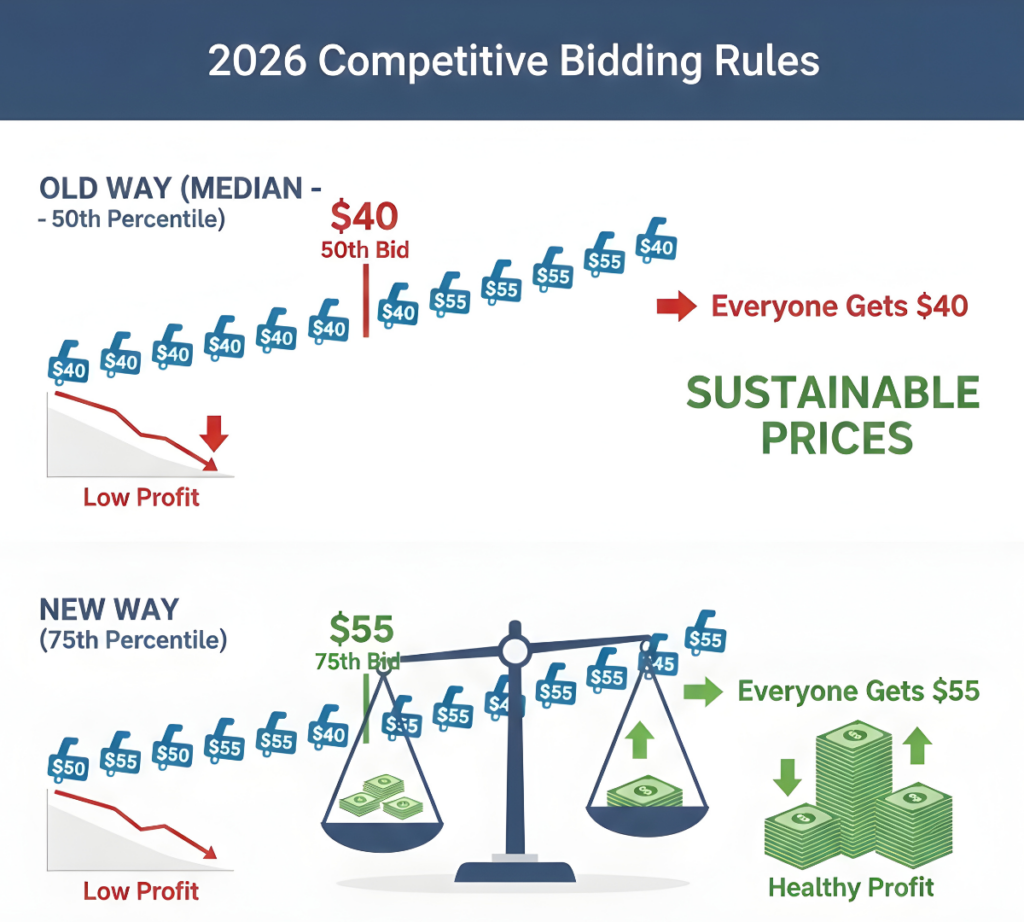
A major victory for the industry in the 2026 Competitive Bidding Rules is the adoption of the 75th Percentile Methodology for calculating Single Payment Amounts (SPAs). Unlike previous rounds that used the “Median” (50th percentile), this new rule sets the reimbursement rate higher up the chain of winning bids. This means providers can bid sustainable, profitable prices and still win a contract, reducing the pressure to “lowball” just to survive.
Introduction:
“I have to bid low to win.”
For 10 years, this was the mantra of competitive bidding. And it drove prices into the ground.
In 2026, the math has changed.
CMS has finalized the rule to set the Single Payment Amount (SPA) at the 75th Percentile of all winning bids.
This sounds like a boring statistics term. It is actually a lifeline for your margin.
The Math: Median vs. 75th Percentile
Let’s imagine 100 suppliers submit winning bids for a walker.
- Old Way (Median): CMS takes the 50th lowest bid. Let’s say it’s $40. Everyone gets paid $40.
- New Way (75th Percentile): CMS takes the 75th bid. Because it’s higher up the list, the price might be $55. Everyone (even the guy who bid $40) gets paid $55.
The Strategy Shift
- Don’t Lowball: If you bid rock bottom ($30), you drag the average down, but you don’t necessarily increase your chances of winning significantly compared to a moderate bid ($50).
- Bid Your Margin: Calculate your true cost plus a healthy profit. With the 75th percentile rule, the “Clearing Price” will likely accommodate quality providers.
The “Pivotal Bid” Factor
The “Pivotal Bid” is the price point where CMS meets beneficiary demand.
- If demand is high, CMS needs more suppliers. They have to accept higher bids to fill the roster.
- Tip: In rural or high-demand categories (like Oxygen), the Pivotal Bid is often quite high. Do not undercut yourself.
WWS Value Proposition: We Model the Clearing Price
Wonder Worth Solutions uses historical data and demand modeling to estimate the “Winning Range” for your region. We help you find the “Goldilocks Price”—not too high to lose, not too low to bleed.
Confused by the new math?
Let’s run the numbers for a Pricing Strategy Consultation.